


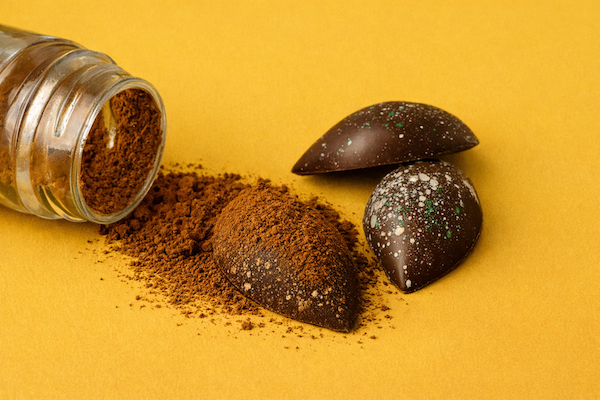

I recently had a conversation with Renata Ramos, who leads marketing and growth at Cellva, a São Paulo-based food-tech company working on the upcycling of coffee pulp into a food ingredient. Their main product, CoffeeCoa, a cocoa-like powder made from coffee pulp, is being positioned as a partial substitute for cocoa. Talking with Renata offered a useful lens into how one of the more ambitious and innovative players in this space is thinking about scaling and positioning these materials.
Over the past few years, we’ve seen a steady stream of attempts to push coffee by-products beyond their traditional uses, as soil amendment, for instance - or not using them at all. Newer ways of upcycling these by-products into things like a valuable compost, making biochar, or using the dried pulp as base for beverages (key words: cascara, cascara extracts) are actually not new anymore. What’s more interesting in my opinion is how some players are starting to position these materials, not just technically, but structurally within the food system.
That’s where Cellva caught my attention. Not because they are working with coffee pulp - that part is familiar - but because of where they are trying to take it. With CoffeeCoa, they are not building a niche product or a functional ingredient for a niche category. They are going directly after cocoa.
That changes the conversation.
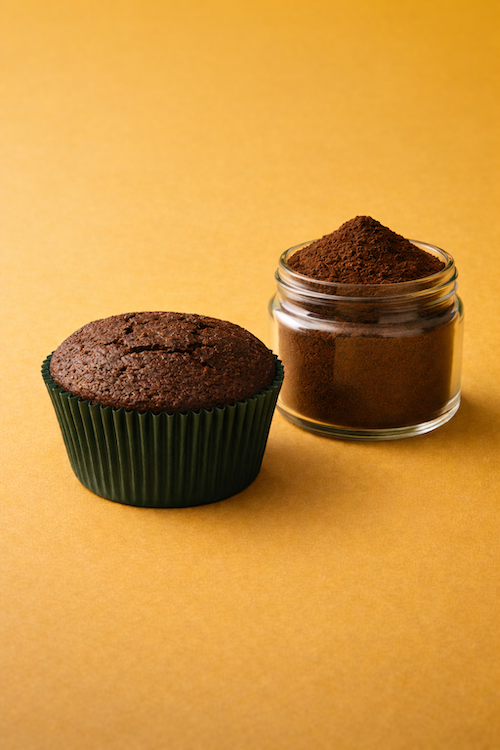
At a technical level, there’s little surprising about this process: Cellva uses methods such as extraction, concentration, and spray drying, and those pathways are well understood. Even the most significant process, microencapsulation, is hardly new. What feels different in this case is not the specific technologies themselves, but how they are being combined with a very clear application target. Instead of staying close to beverage formats or nutraceutical positioning, Cellva is placing the material into applications where cocoa is deeply embedded: chocolate, chocolate-based drinks and beverages, bakery and dairy products, spreads etc. In other words, into categories that already exist at scale and don’t need to be invented.
From what I’ve seen, the product seems to perform well. At the March 2026 Future Food-Tech event in San Francisco, Cellva attracted a great deal of attention. And this is for a good reason: with cocoa substitution levels of around 50 to 60 percent without major sensory deviation of the final product, CoffeeCoa is challenging cocoa suppliers. It is therefore little surprise that this causes serious interest in Cellvas´ product.
A full cocoa replacement, according to Renata, is possible, but then you’re clearly no longer replicating cocoa; the final product would taste different. This raises an interesting question: could a 100% replacement of cocoa create a new flavour and product category? Maybe. However, that would lead to marketing challenges.
To continue this thought: if CoffeeCoa was treated as a 100% cocoa substitute, it would always be compared to cocoa—in terms of flavour, functionality, regulations, and ultimately what consumers expect chocolate to taste like. That might be a difficult position to hold. But if we look at CoffeeCoa as a coffee by-product derived ingredient with its own sensory profile, then the comparison becomes less rigid. In that case, it isn’t replacing something; it’s expanding what is possible in formulations. How that framing evolves would probably matter more than any incremental technical improvement in the sourcing and manufacturing processes.
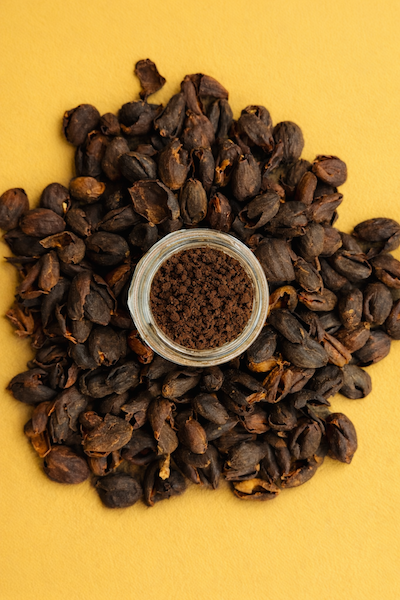
The raw material side is where things start to feel more familiar again. Coffee generates significant volumes of by-products, especially pulp, so feedstock should not be the limiting factor. However, in practice, it rarely stays that simple. The fact that Cellva is intervening early in the coffee processing chain to avoid any kind of contamination or unwanted fermentation (or at least minimize them as much as possible), is telling. It reflects the same reality some of you might have run into at some point: once you move from experimentation to industrialization, control and food safety becomes the central issue.
Presently, Cellva collaborates with 15 coffee farms. Working with a limited number of farms makes sense if you want consistency, compliance – and the volume you actually need. This makes it easier to scale later on as you will have already learned to deal with variability in raw material, contamination risks, differences in farming practices, logistics etc.; none of those concerns disappear, they just become more visible at scale. At a certain point, the material stops being “waste” and becomes “product”; it starts behaving like any other agricultural input that needs to be managed, standardized, and contracted.
In that sense, technology itself is almost the least surprising part of the story. Companies like Cellva are well past the point where extraction or spray drying are the bottleneck. The real constraints are elsewhere—supply consistency, regulatory pathways, positioning, and economics. Cellva is navigating this as a systems integration challenge rather than a pure technology play, which is probably the only way this kind of model has a chance to scale.
The economic argument is, at least for now, quite compelling. Pricing below cocoa (which clearly is Cellvas´ intention) in a market that has been under significant pressure is clearly attractive for food manufacturers. At the same time, it’s worth being cautious about how stable that advantage is. We’ve seen similar dynamics before: as soon as a product or by-product becomes valuable and demand increases, pricing follows. What starts as a low-cost input gradually moves into a more conventional commodity space. The question is not whether that will happen, but how quickly.
One aspect that I haven´t mentioned so far but does stand out positively is the fact that Cellva is actually paying for the coffee pulp. That may sound trivial, but in this space, it isn’t always the case. Too often, the narrative of additional farmer income remains more aspirational than real. Here, at least in the current phase, there is a tangible transfer of value. How that evolves as volumes grow and more actors become involved is, of course, another question - but it’s a meaningful starting point.
Regulations will likely play their usual role as both gatekeeper and time delay. There’s nothing inherently problematic about CoffeeCoa itself, but once you move beyond beverages into broader food applications, especially in markets like the EU, things slow down quickly.
So where does that leave us?
It’s probably too early to call this a fully scalable model, but it’s equally clear that it’s more than a “one-off experiment”. What Cellva is doing pushes the category in a direction that many have been hinting at but few have actually attempted at scale. Processing 1,000 tons of coffee pulp is Cellva´s target for 2026. Moving from niche applications into established ingredient markets is a different level of ambition, and it forces a different set of questions.
For those working in coffee by-product valorization, the broader signal is quite clear. The phase of proving that these materials can be used is largely behind us. The next phase is about where they actually fit, and under what conditions they make sense economically, operationally, and structurally.
In that context, Cellva´s CoffeeCoa is less about cocoa substitution than it is about testing those boundaries. Whether it becomes a widely adopted model or remains a well-executed exception will depend on factors we’ve already mentioned: supply, control, regulation, pricing and positioning.
But as a signal of where the space might be heading, this young and innovative Brazilian company is, under the leadership of its CEO Sergio Pinto, a strong one—and worth watching closely.


.jpg)
